KU Libraries name 2026 Shulenburger Award recipients, honor contributions to open scholarship


The OER Observatory aggregates and displays OER-related news and content from third-party sources worldwide. This content is not produced by UNESCO or the OER Dynamic Coalition. All rights and responsibility for the original content remain with the respective authors and publishers. The inclusion of third-party content in the Observatory does not imply endorsement by UNESCO or the OER Dynamic Coalition. Users can access the original source through the link provided with each item.
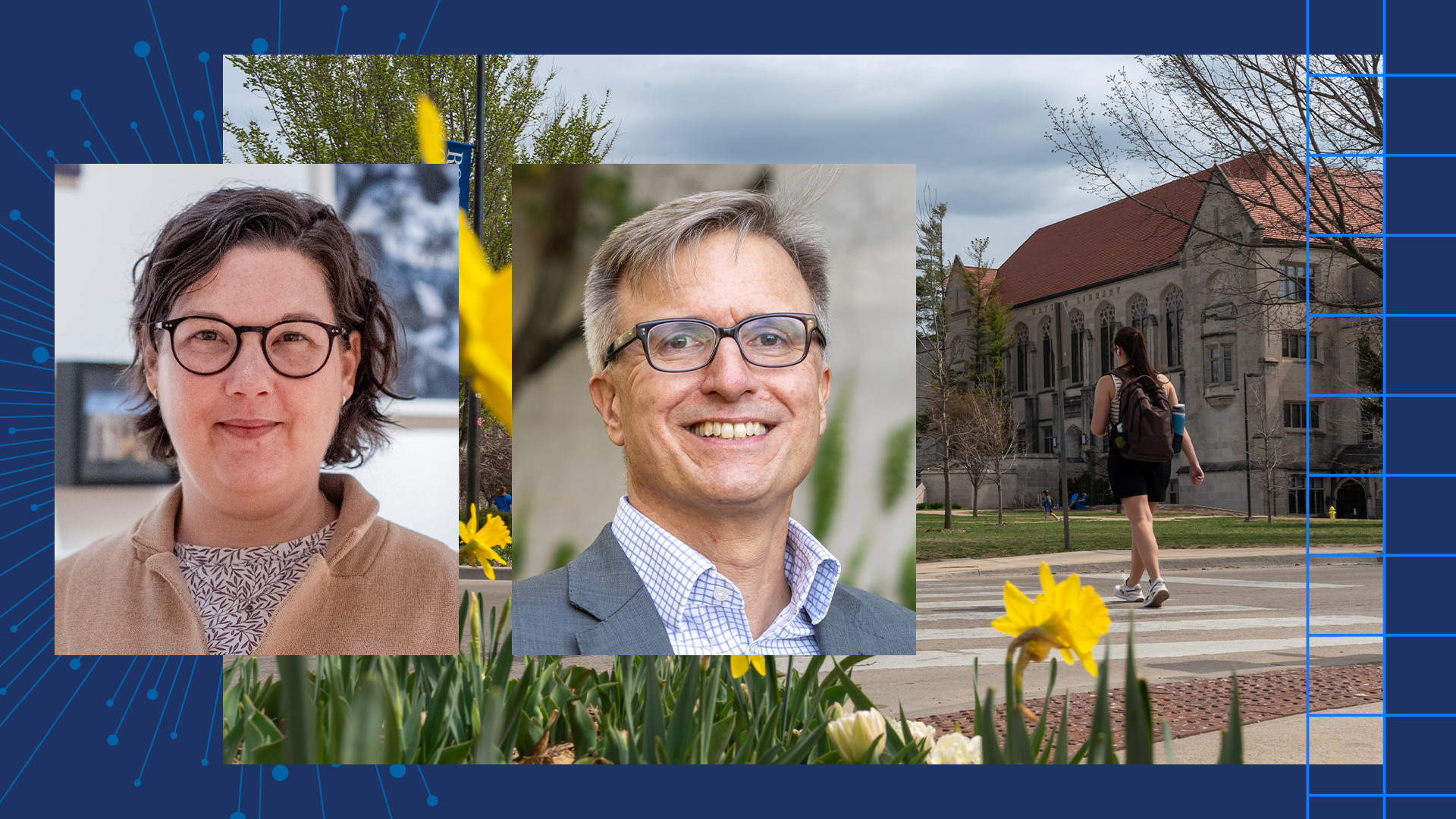
LAWRENCE -- Michael Vitevitch and Emily Casey, two University of Kansas faculty members whose work expands access to scholarship through public engagement, open publishing and research resources, have been named recipients of the 2026 Shulenburger Award for Innovation and Advocacy in Scholarly Communication by KU Libraries.
The award announcement coincides with the libraries' celebration of Open Access Week, along with honorary recognition for recently retired KU colleagues Marianne Reed and Ada Emmett, who were highlighted for their contributions to open scholarship and scholarly communication at KU.
The awardees will be recognized during an Open Access Week webinar at 2 p.m. Oct. 22, featuring Corinna Turbes, senior manager of government relations at SPARC, who will break down the current state of federal public access policy and what it means for scholarly work at KU.
Casey, an early career art historian, was recognized for communicating scholarship in innovative ways, while Vitevitch's advocacy for open science dates back to well before the practice became widely established, according to the award committee.
"This year's Shulenburger Award recipients demonstrate the many ways openness can strengthen scholarship and extend its reach," KU Libraries Dean Carol Smith said. "Michael and Emily approach open scholarship from different disciplines and at different points in their careers, but both show how sharing research, resources and ideas can create new opportunities for discovery and learning."
Michael Vitevitch
A professor of speech-language-hearing, Vitevitch has championed open science for more than 20 years, incorporating open practices across his research, teaching and public engagement. His Phonotactic Probability Calculator, a web-based research tool co-created with Paul Luce in 2004, has been cited more than 700 times and remains a foundational tool in linguistics and psychology.
The tool, which measures how common or rare certain sound patterns are in the English language, has found applications beyond its original research context, including in classroom exercises and therapeutic interventions. Its reach has also extended across languages and disciplines. Vitevitch has advised scholars developing versions of the tool for Spanish and Arabic, while researchers in fields including computer science, physics and mathematics have also applied the tool to their work.
"If it's a useful tool, it should be available to everybody," Vitevitch said. "Instead of hiding information away, making it available to people helps make science more transparent and useful beyond the research community."
Vitevitch's commitment to open access extends across his scholarly work. He publishes in open-access journals, shares research through the KU ScholarWorks online institutional repository and uses an open textbook in his graduate research methods course. He said making research tools and data available can accelerate discovery, support classroom learning and allow people in other disciplines to ask questions that may never have been anticipated by the original creators.
Over the course of his career, Vitevitch has modeled open practices while watching open science grow from an uncommon approach into a movement that is accelerating discovery, expanding access and creating new possibilities for research and learning.
"There are just some amazing databases out there that did not exist 10 or 20 years ago, and they're being used in ways that the people who made them probably didn't think they would be used," Vitevitch said. "I think it's accelerating science, the speed of discovery. It's making it accessible to people."
Emily Casey
The Hall Assistant Professor of American Art and Culture, Casey has advanced open scholarship through open-access publishing, public exhibitions and talks, and digital media. Her work includes the podcast "Breaking the Frame," co-developed with R. Ruthie Dibble at the Peabody Essex Museum, and the 2025 exhibition "Soundings: Making Culture at Sea," co-curated by Celka Straughn at the Spencer Museum of Art. Both projects extend scholarship beyond traditional academic publishing while creating opportunities for student collaboration.
Casey said making scholarship publicly accessible also opens the door to connections that researchers may not anticipate. The "Soundings" exhibition was initially developed with academic peers and Casey's students in mind. However, Casey led a variety of engagements for KU and community audiences through the exhibition and facilitated a variety of student-led public engagement through integration with her class Art and the Sea. The exhibition also reached elementary school groups and the broader community through museum tours.
"I loved the idea that this project I had worked on that was rooted in my research and teaching was activated by people making connections that I couldn't even imagine, sparking connections and experiences I hadn't considered," Casey said.
The collaboration reflects an approach Casey has used throughout her work, making scholarship accessible while creating connections among research, teaching and public audiences. She said her work with KU Libraries has helped shape that approach.
"Getting to know the librarians here and the work that they're doing to make their collections accessible and to make the idea of research accessible has definitely informed my teaching," she said.
Casey collaborates with Andi Back, Fine Arts and Humanities librarian, to bring research skills and tools to the classroom. That partnership will expand this spring in Casey's class African American Art History with a curatorial book project involving additional KU Libraries colleagues and a public-facing component, the latest example of Casey's efforts to bring research, teaching and public engagement together.
Marianne Reed
Reed, who recently retired after nearly 40 years of service to KU, began her career with KU Libraries in 1987. Over the following decades, she held roles across KU Libraries and KU Information Technology before returning to the libraries, where her work focused on digital publishing, repositories and expanding access to scholarship.
Reed's leadership with KU ScholarWorks saw the repository grow to 30,000 items with 1.3 million downloads in 2025. Her support for digital publishing and online scholarly journals and work advancing important digital projects were instrumental to developing the infrastructure, services and relationships that helped expand access to KU scholarship.
Ada Emmett
Ada Emmett, who retired as university ombuds in June, helped establish KU as an early leader in open access, including through her work in the development and implementation of the university's faculty open-access policy. Adopted in 2009, the policy made KU the first public university in the world with a faculty-led, rights-retention open-access policy. Emmett's advocacy extended nationally through the Coalition of Open Access Policy Institutions (COAPI), which she helped establish with KU colleagues in 2011.
During her 20 years as a KU faculty member, Emmett held several roles with KU Libraries, including director of the Shulenburger Office of Scholarly Communication & Copyright. Her work and research in the libraries focused on the scholarly publishing system and issues of equity and access, reflecting a broader commitment to opening scholarship to wider audiences.
About the Shulenburger Award
The Shulenburger Award recognizes KU faculty, staff, students and academic departments that champion open access and innovation in scholarly communication. The award was established in 2014 through a gift by David Shulenburger, former KU provost and executive vice chancellor, to encourage open sharing of the results of research and promote greater equity in access to scholarly endeavors.
Up to two individuals or departments are selected from nominations each year for award amounts between $500 and $3,000. Individual awardees may be invited to serve on KU's Open Access Advisory Board. In all, 18 honorees have been named throughout the award's history.
About KU Libraries
KU Libraries advance open scholarship through programs and services that expand access to research and educational resources, including KU Scholar Works, open-access and digital publishing, open educational resources, and research data management and sharing. The work builds on KU's history as an early leader in open access.