A National Priority for Open Education: Building a National Courseware Ecosystem


The OER Observatory aggregates and displays OER-related news and content from third-party sources worldwide. This content is not produced by UNESCO or the OER Dynamic Coalition. All rights and responsibility for the original content remain with the respective authors and publishers. The inclusion of third-party content in the Observatory does not imply endorsement by UNESCO or the OER Dynamic Coalition. Users can access the original source through the link provided with each item.
The Open Education movement has successfully created a large body of freely available educational content, but it has yet to develop a comprehensive alternative to the commercial courseware ecosystem. Below, I argue that a national priority for Open Education should be to increase equitable access to education by replacing costly and restrictive proprietary courseware with low-cost or no-cost open alternatives. Achieving this requires moving beyond Open Education Resource (OER) production to build a sustainable, nonprofit National Open Courseware Ecosystem that integrates open content with assessment, learning technologies, authoring, accessibility, analytics, AI, and other essential services. Many of these components already exist across the Open community; the opportunity is to connect, coordinate, and scale these efforts into a coherent alternative capable of competing with commercial courseware.
Introduction
In thinking about national priorities recently, I have been reflecting on a session I attended with the Open Education Association (OEA) about how the organization hopes to establish priorities for the open education community.
Before discussing my thoughts on the topic, it is worth explaining my perspective, which requires a brief introduction of myself. I am a Professor and Vice Chair of Undergraduate Affairs in the Department of Chemistry at the University of California, Davis (UC Davis), where my research expertise is in ultrafast laser spectroscopy of photoactive biological proteins. More relevant to this discussion, however, is that I have been involved in the open education community since 2008. That year, I started a project called the ChemWiki as an Open Pedagogy experiment, using students to crowdsource open educational resources (OER) for general chemistry. At the time, I was unfamiliar with many of the acronyms and terminology now commonplace in the field, but that did not stop me from moving forward, albeit somewhat clumsily. The ChemWiki grew by leaps and bounds, eventually becoming the LibreTexts project, of which I am now CEO. Today, LibreTexts operates through two complementary structures: as a grassroots project based at UC Davis and as an independent 501(c)(3) nonprofit organization.
My perspective on discussions about Open Education is heavily influenced by the different hats I wear within the community. I approach these questions simultaneously as an OER author and editor, a faculty member, an academic administrator (low-level), an OER platform developer, and a businessperson trying to build and sustain a nonprofit enterprise. Each of these roles gives me a somewhat different view of both the opportunities and the challenges facing the open education movement. More importantly, they do not always point in the same direction.
The principal thrust of the talks that the OEA has formulated around building national priorities is to identify projects or problems that open approaches, whether OER or other forms of openness, can address. I think this approach has merit because it focuses the conversation on concrete problems rather than on openness as an end in itself. Moreover, it helps create exemplars that can serve as valuable case studies for "growing open."
Goals and Priorities
However, I think the approach of looking for "problems that open can solve" is too limited in scope for a national effort. While identifying specific projects and problems can demonstrate the value of open to potential stakeholders, it risks constraining our ambitions to the problems that are immediately visible or for which an open solution is already apparent. Instead, I believe we need to take a more expansive approach and establish priorities around the outcomes we ultimately want to achieve.
Rather than asking, "What problems can open solve?" we should first ask, "What do we want to accomplish?" We can then identify where open approaches, technologies, and infrastructure can help us achieve those goals. This shifts the focus from using openness as a solution to individual problems toward recognizing openness as a strategy for building the educational system we ultimately want.
So, what is our goal? As with other successful movements, I think it should be simple and straightforward. The challenge is that the "open community" encompasses several distinct but interconnected movements, each with its own goal. For example:
* The goal of Open Education is to remove barriers to education and create an accessible, affordable, adaptable, and participatory system in which everyone can access, use, and contribute to knowledge.
* The goal of Open Science is to make the research process and its products more open, accessible, transparent, reproducible, and collaborative.
* The goal of Open Source is to make software freely accessible, reusable, modifiable, and collectively improvable.
* The goal of Open Pedagogy is to transform learners from consumers of educational content into active participants in creating, adapting, and improving knowledge.
* The goal of Open Data is to make data freely available for access, reuse, analysis, and redistribution, subject to appropriate privacy and ethical protections.
While these movements and other flavors including Open Publishing, Open Government and many others, pursue different objectives, they share a common philosophy that knowledge and the tools for creating and using it should not be unnecessarily restricted. The problem with this broad goal is that it does not provide much actionable direction. The flavor of Open that most directly calls to me, as a faculty member, is Open Education, where this broader principle can be translated into a more tangible objective and mechanism:
Our goal is to increase equitable access to education, educational resources, and information by replacing costly and restrictive proprietary alternatives with low-cost or no-cost open alternatives including OER, open-source technologies, and open pedagogies.
This frames Open Education not as the goal itself, but as a means to achieve a larger objective: ensuring that educational infrastructure, resources, and practices serve students and educators rather than extracting value from them.
The distinction is important. Free and open are not ends in themselves but are tools for building a better educational system. The ultimate measure of success is not how much content we have made open, but whether we have meaningfully improved access, affordability, quality, agency, and outcomes for students and educators.
Within the context of establishing national priorities, it is important to recognize that the majority of activity within the broader Open community is focused on Open Education. Moreover, as a faculty member at UC Davis, I am also particularly motivated to pursue the Open Education goal outlined above, and this is the focus of the remainder of this discussion.
We can Learn from our Competition
I think the open community can learn a great deal from how commercial companies operate. In many ways, commercial companies provide a useful case study in how to pursue a clearly defined goal, coordinate disparate activities, allocate resources, and scale successful approaches. Indeed, they have already achieved something not entirely dissimilar to the goal I proposed above: they have successfully established themselves throughout the educational ecosystem and displaced many publicly developed or freely available alternatives. The question, then, is whether the open community can learn from the strategies that made those companies successful and deliberately apply those lessons toward building open alternatives rather than simply reacting to commercial offerings.
How do commercial companies operate? First, they have a clear product that can be identified, understood, and showcased. Second, that product is increasingly more than simply a textbook. It is a collection of technologies and services: a platform that hosts textbooks and content while complementing them with ancillary technologies such as homework systems, assessment tools, analytics, integrations, and other instructional technologies like AI. Third, companies have a dedicated marketing and sales approach that actively communicates these products to individual faculty, demonstrating how the platforms and technologies can be incorporated into their courses.
This is an important distinction. Commercial companies do not simply build a good product and wait for faculty to discover it. They package the product, make its value proposition clear, and then deliberately take it to the people who make adoption decisions. The open community has generally been much less organized around these three activities: building a recognizable product, integrating complementary technologies into a coherent ecosystem, and actively marketing that ecosystem to faculty.
The Need for a National Open Repository
It is my opinion that we need to build a national repository for OER assets with the ability to integrate into other technologies using open protocols. I understand that this does not align with the decentralized approach to openness favored by many in the community, but I believe some form of centralized infrastructure is critical if we are serious about competing with commercial companies, which is our goal.
A national repository would not need to replace the decentralized creation, ownership, or governance of OER. Rather, it would provide a common point of discovery and act as a place where faculty and institutions could reliably find the open resources and technologies produced across the community. Having centralized infrastructure for OER discoverability would give the community something we currently lack: a recognizable destination that we can point faculty and campuses toward as a viable alternative to commercial offerings. It would also provide a foundation for presenting OER as an integrated ecosystem rather than as a collection of disconnected projects. From a marketing perspective, the value of this cannot be overstated. If we want faculty to choose open alternatives, we need to make those alternatives as easy to find, evaluate, and adopt as the commercial products they are competing against.
This repository should be more than simply a place to host and discover content. If we are serious about competing with commercial courseware companies, it must mirror the broader functionality that those companies provide. In other words, what we need is not merely a national OER repository, but a national Open Courseware Ecosystem.
The Need for a National Open Courseware Ecosystem
This Open Courseware Ecosystem should bring together open content and the technologies needed to use it effectively in the classroom. It should provide the functionality faculty have come to expect from commercial courseware platforms, including homework and assessment, gradebook integration, analytics, accessibility tools, content authoring and remixing, and other ancillary technologies. The goal should be for an instructor to find an open textbook and, from the same ecosystem, access the tools and services necessary to teach an entire course.
Ultimately, the open community should be able to offer a credible substitute for the entire courseware package offered by commercial entities, rather than competing with individual components or individual fields one at a time. Content alone is not enough. If commercial companies win because they provide an integrated package of content, technology, support, and adoption infrastructure, then the open community needs to build an equally coherent open alternative.
The key is to go beyond simply building OER and instead build the infrastructure that supports a comprehensive OER ecosystem. This infrastructure should serve as a central repository for OER textbooks, OER homework question banks, ancillary materials, and the associated technologies needed to use, adapt, and deliver these resources. This includes homework and assessment platforms, learning platforms, interactive tools, authoring and remixing technologies, and other services that enable faculty and students to engage with OER as an integrated courseware ecosystem rather than as a collection of individual resources.
The goal, therefore, should not simply be to produce more open educational content. It should be to create an open, curatable, and sustainable infrastructure through which that content can be discovered, adopted, remixed, delivered, assessed, and continually improved by the community and, importantly, can mano a mano compete with commercial alternatives.
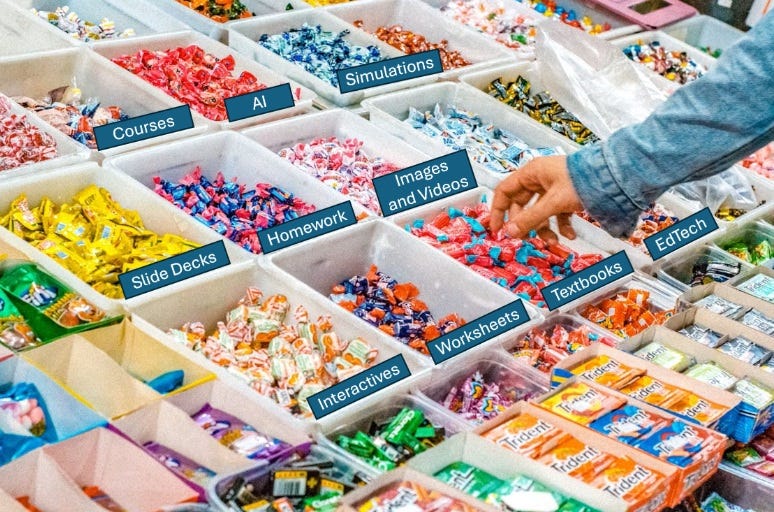
This Open Courseware Ecosystem would serve as a centralized "Open Candy Store" for the community where students, instructors, authors, and others can easily discover, access, adopt, and contribute open educational materials and technologies. The goal is to make open resources as easy to find and use as their commercial alternatives.
Without this infrastructure, we are not truly building a viable alternative to commercial courseware. While we may be producing excellent open resources, we are not competing in the same arena. To achieve the goals outlined above, open education must provide not only open content, but the infrastructure, technologies, and services necessary to make that content a compelling, fully functional alternative.
Absent a viable courseware ecosystem, we will never achieve the goals outlined above. That is, we are simply not in the game or at least the game that matters for effecting a large-scale impact.
Core Aspects of the Open Courseware Ecosystem
This proposed OER Courseware Ecosystem should be built and maintained around the core priorities of the open community. That means using open-source technologies whenever possible, ensuring that content remains openly licensed and accessible, and establishing the infrastructure within a reliable not-for-profit organization. The goal should not be to maximize revenue, market share, or shareholder value, but to build sustainable infrastructure that serves the educational community.
This distinction is important. The ecosystem would still need to operate with the professionalism, reliability, and scale expected of a commercial product, but its underlying purpose would be fundamentally different. Its success should be measured by how effectively it supports faculty and students, expands access to high-quality educational resources, and strengthens the broader open community not by how much money it can extract from the institutions and individuals who depend upon it.
The Open Courseware Ecosystem should encompass more than a collection of openly licensed educational resources. It should provide the content, infrastructure, and technologies necessary to support the full lifecycle of open courseware. Key aspects include:
* OER Textbooks: A central repository of high-quality, openly licensed textbooks that can be adopted, adapted, remixed, and continually improved.
* OER Homework and Assessment: Large, openly licensed question banks aligned with textbooks and courses, supported by technologies for assignment creation, delivery, grading, and feedback.
* Ancillary Materials: Openly licensed instructor resources, lecture materials, presentations, images, simulations, videos, datasets, and other supporting materials.
* Courseware and Learning Platforms: Open-source platforms that allow faculty to combine OER content and assessments into complete courses and deliver them directly to students or through institutional LMSs.
* Authoring and Remixing Tools: Technologies that make it easy for faculty and students to create, modify, combine, and customize OER without requiring specialized technical expertise.
* Interactive and Experiential Learning: Simulations, interactive activities, computational environments, virtual laboratories, and other technologies that extend OER beyond static text.
* Interoperability: Open standards and integrations that allow content, assessments, courses, and student data to move between the ecosystem and existing institutional systems.
* Accessibility and Inclusivity: Infrastructure and tools designed to ensure that resources are accessible to students with disabilities and adaptable to diverse learners and instructional contexts.
* Community Governance and Contribution: A community-driven model that enables faculty, students, institutions, and other contributors to create, review, improve, and share resources.
* Sustainability: A not-for-profit and open-source foundation that prioritizes long-term reliability, community benefit, and preservation rather than commercial extraction.
* Continuous Improvement: Analytics, feedback mechanisms, and community contributions that allow resources and technologies to evolve based on how they are actually used.
* AI-Enabled Infrastructure: Open and responsible AI tools that assist with authoring, adaptation, tutoring, assessment generation, accessibility, translation, and other educational functions while keeping the underlying resources and infrastructure open whenever possible.
* Support: The al-scale usage of this Courseware Ecosystem will require a signigicant infrastructure in place to faciliate customer service. So, building is important, sustainability is important, but hosting and support is also important.
The central principle is that OER content and the infrastructure surrounding it should be developed as a unified ecosystem. The objective is not simply to provide free textbooks, but to create an open alternative to the commercial courseware ecosystem -- one in which the content, technologies, tools, and infrastructure needed to teach a course can be openly accessed, adopted, adapted, and improved by the educational community.
The Open Courseware Ecosystem would be designed as a centralized infrastructure but operate in conjunction with other platforms to facilitate broader distribution and hence bigger impact.
Where LibreTexts May Contribute
There are already multiple platforms that align with specific aspects of the Courseware Ecosystem outlined above, including OER Commons, MERLOT, Runestone, the Open Textbook Library, and many others. Earlier platforms, such as Connexions, also shared much of the same underlying vision and DNA. Complementing these nonprofit initiatives are for-profit organizations such as Lumen Learning, Pressbooks, and other commercial enterprises that provide OER-related infrastructure, albeit often with a more limited scope or through walled-garden environments.
Given my role as CEO and Founder of LibreTexts, it is not surprising that many of the key aspects of the proposed Open Courseware Ecosystem closely parallel the principles that have guided the development of LibreTexts over the past decade. Building an ecosystem that couples open-source technology with OER, along with the ancillary services necessary to make that content a viable alternative to commercial courseware, has been the central objective of the LibreTexts development effort. We refer to this broader ecosystem as the LibreVerse, which can be accessed through the LibreTexts Launchpad (https://launchpad.libretexts.org).
The proposed national OER Courseware Ecosystem does not need to be LibreTexts, nor is my goal here to propose LibreTexts as the national solution. Rather, LibreTexts provides an existing example of what such an ecosystem can look like in practice. It demonstrates that many of the individual components required for such an ecosystem already exist and that the challenge is increasingly one of integration, coordination, sustainability, and scale.
The opportunity, therefore, is not to start from scratch, but to build upon the substantial work already being done across the open education community and connect these efforts into a coherent national courseware infrastructure. The objective should be to create an ecosystem in which open content, open-source technologies, assessment, authoring, accessibility, analytics, and other essential services work together to provide a credible, sustainable, and community-centered alternative to commercial courseware.
References
"National Priorities for Open Education", Open Education Association, online.
Why Can't OER Just Be All in One Place? James Thibeault, Medium, 4-8, 2026.
"Closing the Doors on Open", Lisa Petrides, LinkedIn